Is Your Car Battery Failing? How to Check and When to Replace It
Editorial Team · 15 min read
Last Updated: November 4, 2026
Quick Summary
Car battery health measures how much usable energy a battery can still deliver compared with when it was new, which differs from its state of charge. A resting voltage of 12.7V or above indicates a fully charged battery, but a load test is the more reliable check. Slow cranking, dimming headlights and clicking on starting are common warning signs.
- A resting voltage of 12.7V or above indicates a fully charged, healthy battery.
- A single voltage reading does not confirm battery health, so a load test is more reliable.
- A healthy alternator usually produces around 13.7V to 14.7V while the engine runs.
- Test the charging system before replacing a battery that keeps going flat, as a faulty alternator will drain a good battery.
- Replace the battery if it fails a load test, will not hold charge, or shows swelling or leaking.
Table of Contents
- What Car Battery Health Actually Means
- Car Battery Voltage Chart: Reading Your Results
- How to Test a Car Battery with a Multimeter
- Warning Signs of a Weak or Failing Battery
- Why Does My Car Battery Keep Going Flat?
- Battery Terminals, Corrosion and Maintenance Habits
- Replace or Recharge? A Practical Decision Guide
- Mobile Car Battery Replacement: What to Expect
- Booking Your Mobile Battery Health Check with Licence to Chill
- Frequently Asked Questions
Is your car battery failing? Slow cranking, dimming headlights and a clicking noise when you turn the key are the usual warning signs, and most drivers only check the battery after it has already left them stranded. This guide from Licence to Chill explains how to assess car battery health, what the readings mean, and when replacement is the sensible option. We provide mobile vehicle air conditioning and battery testing across Yorkshire, and our IMI-qualified team works from your home or workplace.
What Car Battery Health Actually Means
Car battery health is a measure of how much usable energy a battery can still deliver compared with when it was new. Battery condition is not the same as state of charge. A battery can read a healthy voltage after a drive and still fail to start the car on a cold morning, because its capacity has dropped.
A battery can be fully charged and still be in poor health. The charge reading tells you how much energy is stored right now. The health reading tells you whether the battery can deliver that energy under load, such as when the starter motor draws a heavy current.
Several factors reduce battery health over time: repeated deep discharges, prolonged heat, vibration, corroded connections and frequent short journeys that never fully recharge the battery. Cold weather does not damage a healthy battery, but it exposes one that is already weak, because low temperatures reduce available capacity and increase the starting current the engine needs.
Car Battery Voltage Chart: Reading Your Results
A resting voltage reading, taken with the engine off and the car rested for several hours, gives a quick indication of state of charge. The following guide is commonly used for a standard 12V lead-acid car battery:
- 12.7V or above: Fully charged and in good condition
- 12.4V to 12.6V: Around 75% charged, generally acceptable
- 12.0V to 12.3V: Low charge, recharge the battery and retest
- Below 12.0V: Discharged, and possibly damaged if it stays this low
A single voltage reading does not confirm battery health. A battery that reads 12.6V can still fail under load. This is why a load test, which measures how the battery performs when it is asked to deliver current, is the more reliable check. Voltage readings are most useful as a starting point, and they should be interpreted alongside the other signs covered in this guide.
How to Test a Car Battery with a Multimeter
A digital multimeter can give you a useful voltage reading at home, provided you take the measurement correctly.
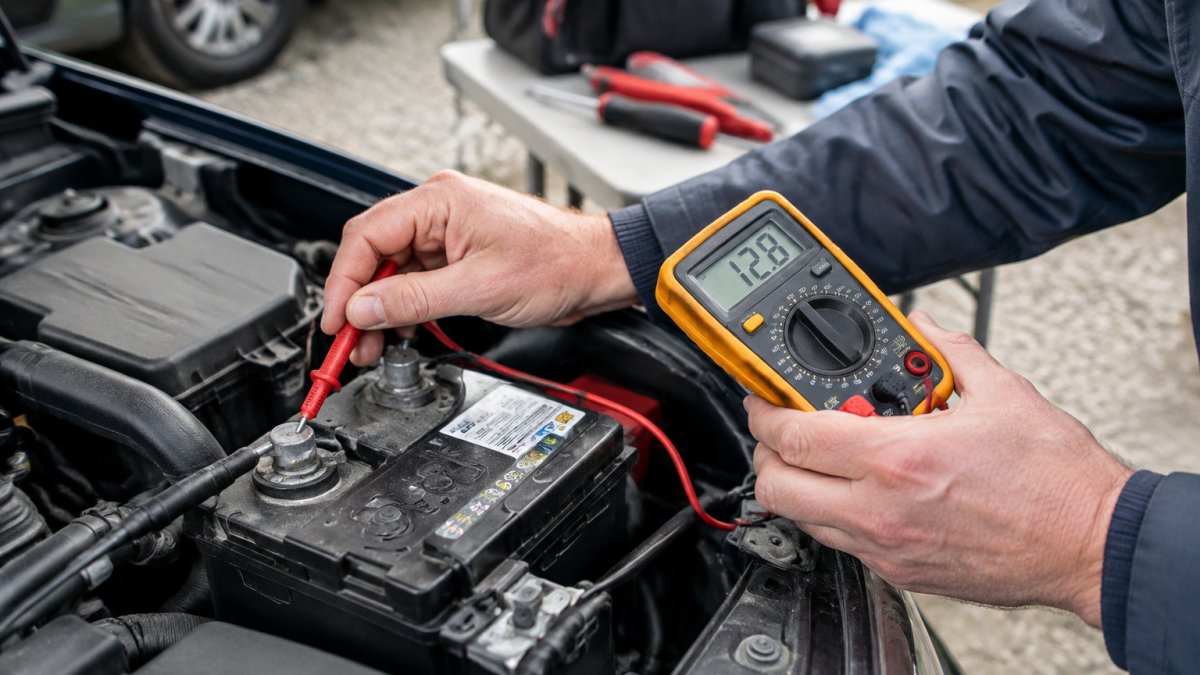
- Switch off the engine and all electrical loads. Remove the key, turn off the lights and close the doors so that the reading reflects the battery alone.
- Set the multimeter to DC voltage. Choose a range above 12V, typically the 20V setting.
- Connect the probes. Place the red probe on the positive terminal and the black probe on the negative terminal, making firm contact with the metal.
- Read the resting voltage. Note the figure and compare it with the voltage chart above.
- Check the charging system. Start the engine and measure again. A healthy alternator usually produces around 13.7V to 14.7V while the engine runs.
A multimeter cannot measure cold-cranking capacity, so a reading in the healthy range does not prove the battery will start the car in winter. For a conclusive assessment, a dedicated battery tester or load test is needed. Taking a reading is safe, but avoid creating short circuits across the terminals, and always keep sparks and naked flames away from the battery.
Warning Signs of a Weak or Failing Battery
Several symptoms often appear before a battery fails completely:
- The engine cranks slowly, especially on cold mornings
- Headlights dim when the car idles or when the starter is used
- Electrical features, such as windows or the radio, behave sluggishly
- A clicking sound when turning the key, which often indicates insufficient current for the starter motor
- Warning lights on the dashboard, including the battery light
- The battery case is swollen, cracked or leaking
- A strong smell of rotten eggs, which can indicate overheating or internal damage
Any of these symptoms warrants a test. A battery that is more than four or five years old deserves particular attention, though age alone does not determine condition, as heat and driving habits play a large part.
Why Does My Car Battery Keep Going Flat?
A battery that repeatedly goes flat is usually a symptom of another problem rather than a battery that has simply reached the end of its life. Two common causes are parasitic drain and charging system faults. Before replacing a battery that keeps going flat, it is worth identifying which one is responsible.
Parasitic drain and electrical faults
Parasitic drain is current that continues to flow from the battery when the car is switched off. Some drain is normal, because the clock, alarm and engine management system need a small amount of power. Excessive drain can come from a faulty component, a light left on, an aftermarket accessory wired incorrectly or a relay that fails to switch off. A faulty interior light switch or boot light is a common example. Checking for parasitic drain requires measuring current draw with the car locked, and it is usually best left to a technician with the right equipment.
Charging system faults versus battery faults
The alternator recharges the battery while the engine runs. A failing alternator, a worn drive belt or a faulty voltage regulator can leave the battery undercharged, which causes repeated flat-battery events even when the battery itself is sound. Conversely, a battery that cannot hold charge will flatten even when the charging system works correctly. A charging system test measures the output while the engine runs, which helps separate the two causes. An accurate diagnosis at this stage saves money, because replacing a good battery will not fix a faulty alternator.
Battery Terminals, Corrosion and Maintenance Habits
Good electrical connections are essential for a battery to deliver its full output. Corrosion on the terminals, usually a white or blue-green crust, increases resistance and can prevent the starter from receiving enough current. Loose clamps have a similar effect.
Simple maintenance helps extend battery life:
- Inspect the terminals and clamps every few months for corrosion and tightness
- Clean corrosion with a mixture of bicarbonate of soda and water, using a stiff brush, and rinse with care
- Disconnect the negative terminal first and reconnect it last when working on the battery
- Avoid leaving accessories switched on with the engine off
- Take longer journeys regularly, as short trips may not restore the charge used by starting the engine
- Keep the battery securely mounted to reduce vibration damage
Good habits will not reverse a worn-out battery, but they prevent many avoidable failures.
Replace or Recharge? A Practical Decision Guide
Once the test results are in, the decision should follow a sequence rather than a hunch.
Step 1, Confirm the battery is actually charged. Put the battery on a smart charger until it reaches a full charge, then let it rest for several hours before retesting. If the resting voltage climbs back to around 12.6V to 12.7V and holds there, the battery can accept and store charge.
Step 2, Load-test the battery. A voltage reading alone will not reveal cold-cranking capacity. A dedicated battery tester or a load test applies a heavy current draw and measures how far the voltage drops. A battery whose voltage falls sharply under a load test, or recovers slowly afterwards, is generally treated as a replacement candidate.
Step 3, Check the charging system before condemning the battery. With the engine running, measure the voltage at the battery terminals. A healthy alternator typically holds the system at around 13.7V to 14.7V.
Step 4, Rule out parasitic drain. If the battery is sound and the charging system is healthy but the car still goes flat, measure the current draw with the vehicle locked and all modules asleep.
Step 5, Decide. Recharge and monitor if the battery was simply discharged once, for example after lights were left on, and it then holds charge and passes a load test. Investigate the charging system or a drain if the battery recharges but the problem recurs.
Watch out: a battery that passes a load test in mild weather can still fail on the first hard frost, because cold reduces available capacity and raises the starting current the engine demands.
When replacement is the answer, the next decisions are fitment and cost.
On cost, expect a wide range depending on the vehicle and battery type. A conventional battery for a small car typically sits at the lower end, while an AGM or EFB unit for a start-stop vehicle costs more, and fitting, registration and old-battery recycling add to the total.
The table below summarises the five steps for deciding whether a battery should be recharged, investigated or replaced.
| Step | What to do | Key check |
|---|---|---|
| 1. Confirm charge | Full charge, then rest several hours | Holds around 12.6V to 12.7V |
| 2. Load test | Apply heavy current draw | Voltage drop and slow recovery |
| 3. Charging system | Measure with engine running | Roughly 13.7V to 14.7V |
| 4. Parasitic drain | Measure current with vehicle locked | Above expected standby figure |
| 5. Decide | Recharge, investigate or replace | Fails load test or won't hold charge |
Mobile Car Battery Replacement: What to Expect
A mobile battery service brings the assessment and the fitting to wherever the vehicle is parked, which avoids the time and inconvenience of a garage visit. The workflow below is what a well-run mobile visit should look like, and it is worth knowing so you can judge whether a service is doing the job properly.
Before the visit. The technician should confirm the vehicle's registration, make, model, year and engine, and whether it has a start-stop system, so the correct battery specification can be brought to the job. Supplying the registration in advance lets the battery be matched to the manufacturer's fitment data rather than guessed from appearance.
On arrival, assess before replacing. A mobile technician should test the existing battery and the charging system before removing anything, which means a resting voltage check, a load test of the battery and a charging-system check with the engine running.
Fitment checks. The replacement battery must match the original specification: physical dimensions and group size, terminal layout and polarity, hold-down and venting arrangements, capacity in amp-hours and cold-cranking amps, and the correct chemistry, conventional lead-acid, enhanced flooded battery (EFB) or absorbed glass mat (AGM), for vehicles with start-stop or regenerative charging.
Safe removal and fitting. The negative terminal should be disconnected first and reconnected last to reduce the risk of short circuits, and the battery should be handled with care because it contains sulphuric acid and can produce explosive hydrogen gas.
After fitting. Ask the technician to confirm that the charging voltage and electrical functions are working after fitting. Some vehicles lose radio codes, window or sunroof positions or other memory settings when the battery is disconnected, so ask whether these will need resetting.
What it costs. Mobile battery replacement pricing varies with the vehicle and the battery type. Always ask for a quote that itemises the battery specification, whether registration is included and how the old battery will be recycled, so you can compare options fairly.
Watch out: a mobile technician who arrives with a battery before testing the vehicle, or who cannot explain the test readings, may be fitting a battery over a charging-system or drain fault. Ask for the assessment first and be wary of a replacement offered without one.
For current pricing and availability, contact Licence to Chill directly.
Booking Your Mobile Battery Health Check with Licence to Chill
If your battery is showing warning signs, or it has gone flat more than once, a professional check is the quickest way to find the cause. Licence to Chill offers mobile battery testing and practical replacement advice across Yorkshire, bringing the service to your home or workplace. Our IMI-qualified father-and-son team provides clear, understandable findings and printed reports you can share with another repairer.
We will tell you whether your battery can be recharged, whether another fault is responsible or whether replacement is needed. To get in touch and arrange a visit, contact Licence to Chill today.
Frequently Asked Questions
How can I check my car battery's health at home?
Start with a resting voltage test using a digital multimeter set to DC volts. Switch the engine off, wait at least an hour after driving if possible, then touch the probes to the battery terminals. A fully charged battery should read around 12.6V or higher. Follow this with a cranking test: have someone turn the ignition while you watch the voltage. If it drops below about 9.6V during cranking, the battery may be struggling. Results are indicative rather than conclusive, so combine them with symptoms and age before deciding on action.
What voltage should a healthy car battery show?
A healthy 12V lead-acid car battery typically reads between 12.4V and 12.7V when resting with the engine off. A reading of 12.6V or above indicates a full charge. Readings around 12.0V suggest the battery is roughly half charged, and anything below about 11.9V usually means it is deeply discharged. With the engine running, the charging system should show roughly 13.7V to 14.7V. Readings outside these ranges point to either the battery or the charging system needing attention.
How can I tell if my car battery needs replacing?
Replacement is worth considering if the battery is over around four to five years old, struggles to start the engine on cold mornings, shows a resting voltage that does not recover after a full charge, or has a swollen or cracked casing. Repeated jump starts are another clear sign. If a load test shows poor capacity even after charging, replacement is usually the practical option. Where the battery is still within warranty, check the terms before paying for a new one.
Why does my car battery keep going flat?
Common causes include a parasitic drain from a fault or accessory left drawing power, a failing alternator that does not recharge the battery while driving, corroded or loose terminals, and frequent short journeys that never fully replace the charge used to start the engine. Extreme cold also reduces available capacity. Testing the charging system and checking for a drain with the engine off will help separate battery faults from wider electrical problems before replacing anything.
Can a mobile technician replace a car battery at home?
In many cases yes, provided the technician has the correct replacement battery for your vehicle and can access the battery safely. Fitment depends on size, terminal layout, and whether the vehicle needs its settings reprogrammed after disconnection. Ask whether the service includes testing before fitting, how the old battery will be disposed of, and whether the new battery carries a warranty. Costs vary, so request a written quote before booking.
How long does a car battery test take?
A basic voltage and cranking test usually takes under 15 minutes. A fuller assessment, including a load test and a check of the charging system, typically takes between 20 and 30 minutes. If a parasitic drain is suspected, the check may take longer because current draw must be measured with the engine off over a period of time. Timings depend on the vehicle and how accessible the battery is.
Should I replace a car battery or try charging it first?
Charging a flat battery first is sensible if the flat was caused by leaving lights on or a one-off event. Fully charge it, retest the resting voltage, and see whether it holds charge over a day or two. If it drops quickly again, or load testing shows poor capacity after charging, replacement is the more reliable option. Repeated discharges usually indicate either an ageing battery or an underlying fault that needs diagnosing.
