The Complete Guide to Car Battery Health Testing
Editorial Team · 15 min read

Quick Summary
Car battery health describes whether a battery can still deliver enough power to start the engine, which matters more than how full it is. Charge only shows the energy stored right now, while health shows if the battery holds up under load. A quick test with a load or conductance tester reveals health before a breakdown happens.
- A battery can read 12.6 volts at rest yet still fail to start the car on a cold morning.
- Resting voltage below about 12.4 volts means the battery needs charging before health can be judged.
- Cranking voltage should stay above roughly 9.6 volts on a 12-volt system during starting.
- Wait at least an hour before a resting voltage check, as a fresh charge reads artificially high.
- Corroded terminals can cause slow cranking, so check and tighten clamps before replacing the battery.
Table of Contents
- Why Car Battery Health Matters More Than Charge
- Signs of a Failing Car Battery to Watch For
- Safety Checks Before You Test Your Battery
- Visual Inspection, Terminals and Corrosion Checks
- How to Test a Car Battery Without a Tester
- Car Battery Voltage Test: Readings and What They Mean
- Electric Vehicle Batteries: Degradation and Usable Capacity
- What to Do After a Failed or Borderline Test
- Booking Your Mobile Battery Check at Home or Work
- Frequently Asked Questions
Why Car Battery Health Matters More Than Charge
A car battery that reads 12.6 volts on a meter can still leave you stranded on a cold Monday morning, which is why car battery health matters more than the reading alone. That is the core problem with judging a battery by how full it is. Charge tells you how much energy is in the battery right now. Health tells you whether the battery can still deliver that energy when the engine demands it. Mobile battery checks focus on health, because that is what decides whether your car starts.
Most drivers only think about the battery when the engine turns over slowly or not at all. By then the damage is usually done, and a simple test would have flagged the problem weeks earlier. Understanding the difference between charge and health helps you read results correctly and decide what to do next.
State of charge versus state of health explained
State of charge is the percentage of energy stored in the battery at a given moment. A battery sitting at 100 per cent charge can still be weak if its internal plates have sulphated or its capacity has dropped with age. State of health describes the battery's overall ability to store and deliver power compared with when it was new.
Think of it like a fuel tank with a crack in it. A full tank tells you nothing about whether the tank leaks. Charge is the fuel level; health is whether the tank still holds fuel properly. Testing for health usually means applying a load and measuring how the voltage holds up, rather than just checking the resting voltage.
Why a fully charged battery can still fail
A battery can show a healthy voltage at rest and still fail under load. The engine starter draws a large surge of current for a few seconds, and a tired battery may not sustain that surge. Cold weather makes this worse, because chemical reactions inside the battery slow down and capacity falls.
This is why a quick voltage check on its own can give false reassurance.
Signs of a Failing Car Battery to Watch For
Batteries rarely fail without warning. Most give several clues over days or weeks, and recognising them early saves you from a breakdown. The sooner you act on the first sign, the cheaper and simpler the fix tends to be.
Slow cranking, dim lights and warning lights
Slow cranking is the classic symptom. The engine turns over more lethargically than usual, especially on cold mornings. Dim headlights or interior lights that brighten when you rev the engine also point to a battery struggling to hold charge. A battery warning light on the dashboard may indicate a charging system fault rather than the battery alone.
Other signs include a clicking noise when you turn the key, electrical accessories behaving oddly, or a battery case that looks swollen. Any bulging, cracking or leaking is a reason to stop and get the battery inspected, because a damaged case can be dangerous.
Why your car battery keeps going flat
If your battery goes flat repeatedly, the cause is not always the battery itself. A parasitic drain, where something draws power when the car is off, can empty even a good battery overnight. Short journeys that never fully recharge the battery also drain it over time. An alternator that is not charging properly leaves the battery to run down while you drive.
A battery health test helps separate these causes. Our guide to checking whether your car battery is failing explains how to judge a borderline result. If the battery tests well but still goes flat, the fault probably lies elsewhere in the electrical system, and further diagnosis is needed.
Safety Checks Before You Test Your Battery
Car batteries contain sulphuric acid and can release hydrogen gas, which is flammable. Before you touch anything, switch off the engine and remove the keys from the ignition. Keep sparks, cigarettes and open flames well away from the battery area, and work somewhere with good ventilation.
Wear eye protection and nitrile or rubber gloves. If you spill battery acid on your skin, rinse it with plenty of clean water and seek medical advice if irritation persists. Never test a battery that is cracked, leaking or visibly swollen, as these need professional handling.
Modern vehicles add another consideration. Many cars have electronic control units that wake up when the battery is disconnected, and some need a code reset afterwards.
Visual Inspection, Terminals and Corrosion Checks
Start with a visual inspection. Look at the battery case for cracks, bulging or staining around the edges, which can indicate overheating or internal damage. Check the vent caps on conventional batteries and make sure the battery is firmly secured, because loose batteries vibrate and wear out faster.
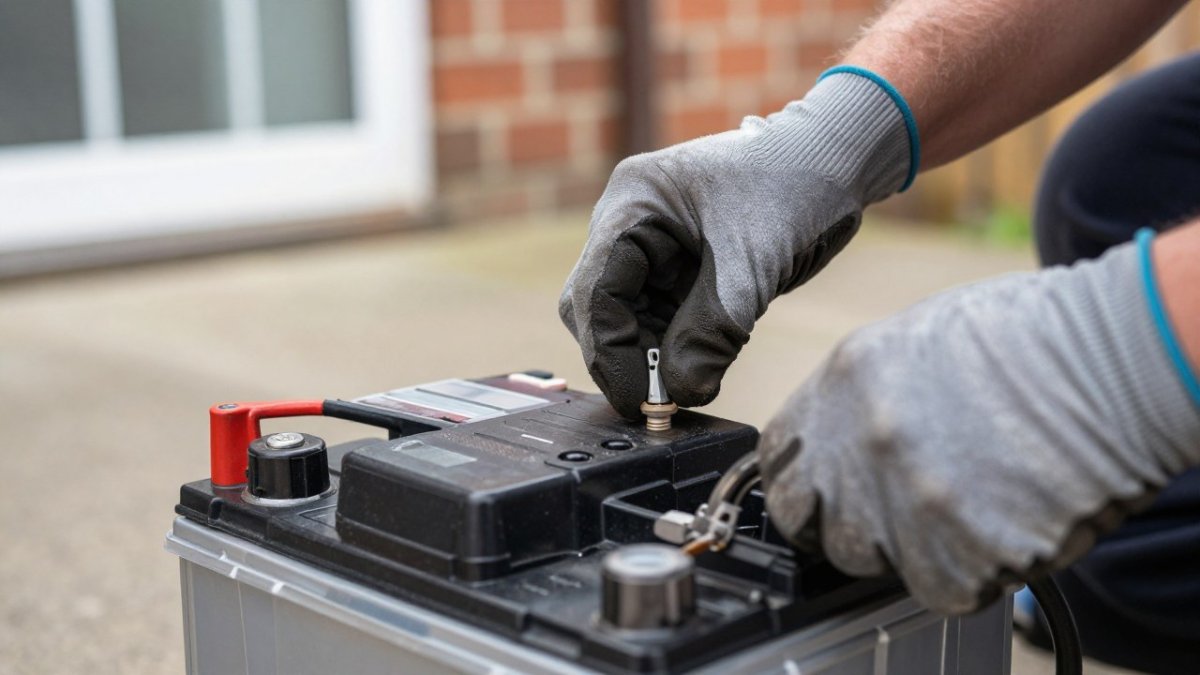
Next, examine the terminals. A white, green or blue crust around the posts and clamps is corrosion, and it increases electrical resistance. Corroded terminals can cause slow cranking even when the battery itself is sound. Tighten the clamps so they cannot be twisted by hand.
Corrosion is a common and inexpensive fix, so it is worth checking before assuming the battery is finished.
How to Test a Car Battery Without a Tester
You do not need specialist equipment to get a rough idea of battery condition. Start by checking the resting voltage with the engine off and the car rested for at least an hour. A fully charged 12-volt battery usually reads around 12.6 volts or slightly above. Readings below about 12.2 volts suggest the battery is significantly discharged.
Next, watch the headlights. With the engine off, switch on the headlights for a minute, then press the starter briefly while watching them. If they dim sharply or go out, the battery is struggling under load.
These checks are useful, but they are indicators rather than proof. A battery can look fine in these simple tests and still fail under real demand, which is why a dedicated load test gives a more reliable answer.
Car Battery Voltage Test: Readings and What They Mean
Voltage readings only make sense when you know what stage of the test they come from and what else is affecting the number on the screen. A single threshold applied to every car in every season will mislead you. The three measurements below are the ones that matter, and each needs reading in context.
Resting voltage, cranking voltage and charging voltage
Resting voltage is measured with the engine off and the battery left to settle. A common rule of thumb is to wait at least an hour after the last charge or drive, because a battery that has just been charged holds a surface charge that reads artificially high.
Cranking voltage is measured while the engine is being started. It should stay above roughly 9.6 volts during cranking on a 12-volt system. If it falls sharply, the battery cannot supply enough current for the starter, even if its resting voltage looked fine.
Charging voltage is measured with the engine running, typically between about 13.7 and 14.7 volts. A reading outside this range points to the alternator or voltage regulator rather than the battery itself. On vehicles with smart charging or start-stop systems, the charging voltage may deliberately drop or rise as the management system decides, so a single low reading is not automatically a fault.
Reading results with context, not one universal threshold
A voltage figure is only meaningful alongside four pieces of context: battery type, temperature, resting time and the manufacturer's specification.
Battery type matters because absorbent glass mat (AGM) and enhanced flooded batteries used on start-stop vehicles often rest slightly higher than a conventional flooded battery, and some manufacturers publish different acceptable ranges.
A simple decision path helps. First, confirm the battery has rested and is at a sensible temperature. Second, check resting voltage: below about 12.4 volts, charge and retest before judging health. Third, if resting voltage is acceptable, measure cranking voltage and charging voltage. Fourth, compare all three against the manufacturer's figures for your model.
Watch out: a battery that passes a resting voltage check but drops below about 9.6 volts during cranking is failing under load, and no amount of recharging will restore lost capacity.
Using a dedicated battery tester and load test
A dedicated battery tester, often a conductance or load tester, gives a more definitive picture than a multimeter. A load test applies a controlled current to the battery and measures how the voltage responds. A healthy battery holds its voltage under load, while a weak one drops quickly.
Both methods are more informative than a multimeter alone, and both should be read against the battery's rated cold-cranking amps and the manufacturer's specification. Licence to Chill's mobile service carries out these tests on site, and the printed report shows the readings so you can review them yourself.
Government guidance on vehicle maintenance and roadworthiness
The article gives these voltage readings and thresholds, which a reader can compare at a glance.
| Measurement | Reading | Note |
|---|---|---|
| Resting voltage (full charge) | Around 12.6 V | Conventional lead-acid battery |
| Resting voltage (needs charging) | Below about 12.4 V | Charge before judging health |
| Cranking voltage | Above roughly 9.6 V | 12-volt system, during starting |
| Charging voltage | About 13.7 to 14.7 V | Engine running |
| Rest time before testing | At least one hour | Avoids surface charge |
Electric Vehicle Batteries: Degradation and Usable Capacity
Electric vehicles use large lithium-ion traction batteries, and the testing logic is different from a 12-volt starter battery. Most EVs still have a 12-volt battery that powers accessories and wakes the high-voltage system, so that smaller battery should be tested in the usual way. The traction battery needs a different approach.
What state of health means on an EV
State of health on an EV describes the traction battery's current usable capacity compared with its capacity when new. A battery rated at 100 per cent state of health when new might read 90 per cent after several years, meaning it stores about nine-tenths of the energy it once did.
State of charge is different. It is simply how full the battery is right now. A car can show 100 per cent state of charge and still have reduced state of health, because the battery is full relative to its current, diminished capacity. This is the same charge-versus-health distinction that applies to a starter battery, just on a larger scale.
Degradation, range loss and charging behaviour
Degradation shows up as reduced usable capacity, which the driver experiences as less range from a full charge. It is driven by charging cycles, heat exposure, frequent rapid charging and the way the battery is treated over its life. A car that has been mostly rapid-charged and left at high charge in hot weather will typically degrade faster than one charged gently at home.
Charging behaviour is a useful clue. If the car takes noticeably longer to charge to the same percentage, or the indicated range at full charge has fallen steadily, the battery management system is likely compensating for lost capacity.
Reading battery-management-system estimates
The battery management system estimates state of health from voltage, current and temperature data over time. These estimates are useful but not exact, and they can be affected by recent charging patterns and temperature. Treat a single reading as an indicator, not a verdict.
When buying a used EV, ask for the state-of-health figure and compare it with the car's age and mileage. A figure well below what the manufacturer's warranty treats as normal is a reason to ask questions before committing.
Watch out: do not attempt to open or service a high-voltage traction battery yourself. Diagnosis should be left to trained technicians with appropriate equipment and safety training, and the high-voltage system must be isolated before any work begins.
Government guidance on electric vehicle charging and safety
What to Do After a Failed or Borderline Test
A failed test means the battery can no longer reliably start the engine and should be replaced. A borderline result is less clear-cut.
If the battery is borderline, first check the charging system and terminals, since a fault there can mimic a weak battery. Consider a full charge with a suitable charger, then retest. If the result does not improve, plan a replacement before the battery leaves you stranded.
When replacing, match the battery's specification to your vehicle, including size, terminal layout and cold-cranking amps. Many suppliers and fitters can advise on the right model. Keep the printed test results, as they help a fitter or garage understand the history of the problem.
Booking Your Mobile Battery Check at Home or Work
Taking a car to a garage for a battery check means losing time and arranging transport. Licence to Chill's mobile service visits your home or workplace in Yorkshire, including Selby, Goole and surrounding areas, so the test fits around your day.
The Chill & Check package at £99.99 covers the checks described above and includes printed findings you can share with any repairer. Our father-and-son team has 38 years of combined motor experience, and our refrigerant handling is IMI-qualified. If the battery tests borderline or failed, we give you practical replacement advice.
To arrange a visit, get in touch with Licence to Chill through our website. You can arrange a home or work visit from our Barnsley-area mobile mechanic for a battery check.
Frequently Asked Questions
How can I test my car battery at home?
Start by checking the battery visually for cracks, bulging and corrosion on the terminals. Then switch the engine and all accessories off, wait a few hours if possible, and measure the resting voltage with a digital multimeter set to DC volts. Connect the red lead to the positive terminal and the black lead to the negative terminal. A reading close to 12.6V suggests a healthy, fully charged battery. For a fuller picture, a dedicated battery tester or a professional load test gives a clearer verdict on car battery health.
What voltage should a healthy car battery show?
A healthy, fully charged 12V car battery typically reads around 12.6V when resting, with the engine off and the car left for a few hours. Readings between 12.4V and 12.6V are generally acceptable, while anything around 12.2V means the battery is about half charged. Below 12V suggests a flat or deeply discharged battery. During cranking, voltage can dip sharply, and a healthy battery should stay above roughly 9.6V. With the engine running, a charging system reading of about 13.7V to 14.7V is normal.
How do I know if my car battery is failing?
Common signs include slow engine cranking, dimming headlights at idle, a battery warning light on the dashboard, a swollen or cracked case, and a sulphur smell. Repeated jump-starts or a battery that goes flat after a few days of sitting are also strong indicators. A battery older than about four to five years is more likely to be near the end of its life, even if it still starts the car. A professional test can confirm whether the battery itself or the charging system is at fault.
Can I test a car battery without a battery tester?
Yes. A digital multimeter is enough for a basic check. Measure the resting voltage with the engine off, then have someone start the engine while you watch the reading during cranking, and again with the engine running. This shows whether the battery holds charge and whether the alternator is charging it. Without a tester, you cannot measure cold-cranking amps or true state of health, so treat the result as an indication rather than a definitive diagnosis.
