How to Know How Long an Aircon Regas Takes
Editorial Team · 12 min read
Last Updated: November 8, 2026
Quick Summary
An aircon regas usually takes 45 to 60 minutes from start to finish, so allowing about an hour is sensible. That covers the full recharge process, including recovery, leak checking, vacuum and refill, rather than just the refill itself. If a leak shows up, the visit becomes a fault-finding exercise and takes longer.
- A full aircon service takes 60 to 90 minutes because it adds component checks to the recharge.
- A regas with a leak found runs to 90 minutes plus, as diagnosis and repair come before any refill.
- Freeing a seized service port can add 10 to 20 minutes to the job.
- A system needing a top-up every six months has a leak, not normal gradual loss.
- Ask what happens if a leak is found and request the readings in writing when booking.
Table of Contents
- How Long Does an Aircon Regas Take? The Short Answer
- The Car Aircon Regas Process, Stage by Stage
- How Long Does a Car Aircon Service Take Compared With a Regas?
- What Can Make an Aircon Regas Take Longer?
- How Often to Regas Car Aircon and Signs It Needs Attention
- Car Aircon Not Blowing Cold Air After Regas: What to Check
- How to Prepare for Your Mobile Regas Appointment
- Book Your Mobile Aircon Regas With Licence to Chill
- Frequently Asked Questions
How Long Does an Aircon Regas Take? The Short Answer
An aircon regas usually takes 45 to 60 minutes from start to finish. Allowing about an hour is sensible, because that covers the full recharge process rather than just the refill itself.
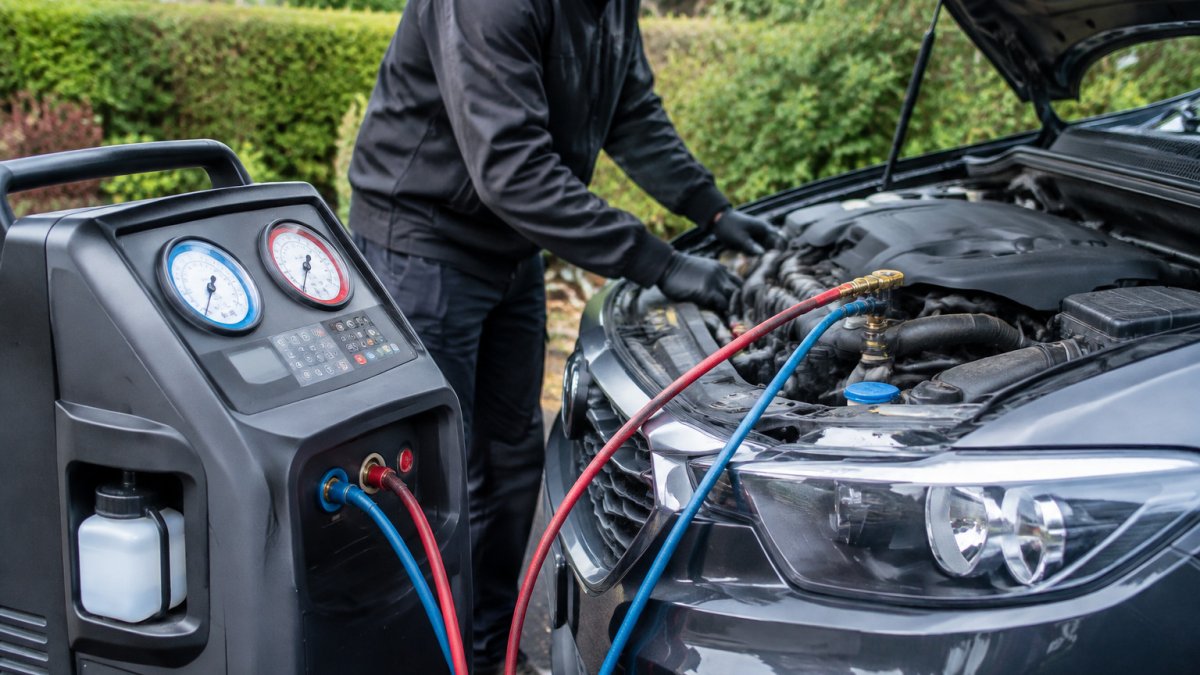
The work moves quickly when the system is sound. A technician removes the old refrigerant, checks for leaks, pulls the system into a vacuum, then refills it to the manufacturer's stated capacity.
What surprises people is how often the job runs longer. If the system has lost pressure or a leak shows up, the visit stops being a simple regas and becomes a fault-finding exercise. That changes the timeline completely.
Below, we break down each stage, explain what adds time, and show you how to prepare so your appointment stays on schedule.
The Car Aircon Regas Process, Stage by Stage
Every proper regas follows the same sequence. Skipping a step is how systems end up half-fixed and blowing warm again a fortnight later.
Here is the standard order of work:
- Connect gauges and measure current system pressure
- Recover the old refrigerant into a sealed cylinder
- Weigh how much gas came out
- Pull a vacuum to remove moisture and test for leaks
- Refill with fresh refrigerant to the correct capacity
- Run the system and check vent temperature
The recovery step matters more than most drivers realise. Refrigerant must never be released into the air (Fluorinated Greenhouse Gases). UK technicians handle it under the F-gas regulations, which is why government guidance on fluorinated greenhouse gases sets out how these gases are recovered and handled.
Removing the Old Refrigerant and Checking for Leaks
Recovery takes only a few minutes. The machine draws the old gas out and stores it, then the technician weighs it to see how much the system had lost.
That figure tells a story. A system that should hold a set amount but gives back far less has a leak somewhere. A vacuum test then confirms whether it holds pressure.
Watch out: a garage that skips the vacuum stage and simply tops the system up is guessing. Without a leak check, you cannot tell a slow leak from normal gradual loss.
Refilling, Pressure Testing and Verifying Vent Temperature
The refill itself is quick, often two to five minutes. The technician adds fresh refrigerant by weight, not by feel, so the charge matches the manufacturer's specification.
Then comes the proof. A thermometer goes into the vent, and the system runs until the air reads cold.
That final check is what separates a real regas from a quick top-up. If the vent temperature stays high, something else is wrong.
How Long Does a Car Aircon Service Take Compared With a Regas?
A car aircon service takes longer than a regas, typically 60 to 90 minutes, because it adds checks the recharge alone does not include. Think of a regas as the refill and a service as the full health check around it.
The extra time goes into inspecting components, checking the receiver-dryer, and looking at belts and cooling fans. Some systems also use a desiccant bag that ages and needs attention.
So which do you need? If the air is cold and the system has not been touched in years, a service makes sense. If the air has gone warm and the system is otherwise sound, a regas is usually the fix.
| Job | Typical Duration | What It Covers |
|---|---|---|
| Regas only | 45-60 minutes | Recovery, leak check, vacuum, refill, vent test |
| Full aircon service | 60-90 minutes | All of the above plus component inspection |
| Regas with a leak found | 90 minutes plus | Diagnosis, plus repair before any refill |
Typical Duration
What Can Make an Aircon Regas Take Longer?
A regas on a sound system is typically a short appointment, while diagnosis is what extends a visit. Anything beyond that is diagnosis, and diagnosis is what stretches the visit. Here is what actually adds time, and roughly how much.
- A leak that shows up under vacuum. The vacuum test is the moment of truth. If the system will not hold a vacuum, the technician has to trace the leak before any refrigerant goes back in. A dye test or electronic leak detector adds further time, and the repair itself is usually a separate job. This is the single most common reason a booked regas turns into a longer visit.
- Seized or corroded service ports. The high and low pressure ports are small and exposed. If a cap has seized or a valve core is damaged, the technician cannot connect cleanly. Replacing a valve core is quick, but freeing a seized port can add 10 to 20 minutes and occasionally means the vehicle has to be moved to a ramp.
- A failing compressor or blocked condenser. If the system holds pressure and takes a full charge but the vent temperature never drops, the refill was not the fault. Diagnosis continues past the recharge, and the technician may need to check compressor operation, condenser airflow and the expansion valve. That can extend the visit, and a repair quote may be needed rather than a completed regas.
- Poor access to the engine bay. Tightly packed engine bays, undertrays and vans with the ports buried behind trim all slow the job down. Access time varies with the vehicle, and vans with undertrays can take longer to reach.
- A busy workshop or a mobile visit with travel between jobs. On a mobile call-out, the clock starts when the technician arrives, not when you book. If the previous job overran, your slot shifts. Ask for a time window rather than a precise time.
There is an important distinction between process time and total visit time. The regas itself, recovery, vacuum, recharge and vent check, takes a set period, and total visit time depends on what is found. The visit includes setting up, connecting gauges, paperwork and, if you have booked a combined package, a battery test. Allow for the whole visit, not just the recharge.
What Happens When a Leak Is Found
This is the part most guides skip. If the vacuum test fails, a responsible technician will not simply add refrigerant and send you on your way. Topping up a leaking system is a temporary fix at best: the gas escapes again, the cooling fades, and you have paid for a regas that did not solve the problem.
The usual next steps are:
- Confirm the leak location. Dye, UV light or an electronic detector pinpoints the joint, hose, condenser or seal that is losing pressure.
- Quote the repair separately. A leaking O-ring is a cheap fix; a holed condenser is not. You should get a clear price before any work continues.
- Repair, then re-vacuum and recharge. The system cannot be properly charged until it holds a vacuum.
A common pattern is for the regas to be paused at the leak-check stage, the repair booked as a follow-up, and the recharge completed once the system is sealed.
How Often to Regas Car Aircon and Signs It Needs Attention
Service intervals vary by manufacturer and vehicle, so check your handbook for guidance on when a recharge is due. A sealed system should hold its refrigerant almost indefinitely.
That distinction matters because it changes what you should book. A regas restores the charge. It does not fix a leak. If you are topping up repeatedly, the money is going out of the system as fast as you put it in.
Watch for these signs of low refrigerant:
- The air feels cool rather than cold
- Cooling fades when you sit in traffic or at a standstill
- The system takes longer to chill the cabin than it used to
- The windows mist up more than they did
- The compressor clicks on and off rapidly (short-cycling)
- The air is cold on one side of the car and warm on the other
If your aircon is blowing warm, it is worth reading up on the common causes before booking a regas. Warm air does not always mean low gas.
A useful rule of thumb: if the system has never been touched and the air is merely weak, a regas is the likely fix.
Car Aircon Not Blowing Cold Air After Regas: What to Check
Cold air should arrive within minutes of a completed regas. If it does not, the refill was not the whole problem.
Start with the simple checks:
- Is the aircon set to cold and recirculation on?
- Is the cabin filter clogged?
- Are the cooling fans running when the system is on?
If those are fine, the fault usually sits deeper: a leak that was missed, an undercharged system, a failing compressor, or a blocked condenser. A proper diagnosis of why your car aircon is blowing warm air will find the cause rather than mask it.
This is where a printed report helps. If a specialist records the pressures and vent temperatures, you have evidence to share with a repairer, and no one can tell you the system was fine when it was not.
How to Prepare for Your Mobile Regas Appointment
A little preparation keeps the visit inside the hour. None of it is complicated.
- Park where the technician can reach the front of the vehicle
- Have the keys ready and the bonnet release working
- Clear any clutter from the passenger seat and footwell
- Note down when the air last felt properly cold
- Ask what refrigerant your vehicle uses, R134a or R1234yf
That last point matters. The two refrigerants are not interchangeable, and the wrong one can damage the system. A good technician checks the under-bonnet label before connecting anything.
Before you book, it is worth checking whether your postcode is covered for a mobile visit. We cover Selby, Goole and the surrounding area, with wider visits by agreement. Send your postcode to check coverage.
Ask two questions when you book: what happens if a leak is found, and will you get the readings in writing. Clear answers tell you the job will be done properly.
Book Your Mobile Aircon Regas With Licence to Chill
You do not need to lose a morning at a garage. Our mobile aircon regas service comes to your home or workplace, so your day carries on while we work.
We are a father-and-son team with 38+ years of combined motor experience, and we handle refrigerant as IMI-qualified technicians. Visits follow a structured process including recovery, leak checking, vacuum, refill and a check of vent temperature.
Our £99.99 Chill & Check package includes the aircon recharge, a 12V battery test, and a printed diagnostic report.
If you are weighing up the cost against the time, our Chill & Check package details set out exactly what is included.
Warm air on a hot day is one of those problems that gets worse the longer you ignore it.
Frequently Asked Questions
How long does a car aircon regas take?
The appointment length depends on the system. The technician needs time to recover the old refrigerant, pull a vacuum to check for leaks, refill to the manufacturer's specified capacity and verify the vent temperature drops. If a leak or faulty component is found, the appointment can run longer because the fault needs diagnosing and may need a follow-up visit once parts are sourced.
Can I drive my car straight after an aircon regas?
Yes. There is no waiting period, and you can drive normally as soon as the technician finishes. Run the air conditioning on its coldest setting for the first few minutes to confirm it blows cold air. If the cooling performance drops again within days or weeks, that points to a leak that a simple regas cannot fix, so ask for a leak check rather than another top-up.
Does a regas fix a car aircon that is not blowing cold air?
It depends on why the system stopped cooling. If the refrigerant has simply escaped slowly over time, a regas restores cooling performance. If there is an active leak, a blocked receiver-dryer or a failed compressor, a regas alone will not solve it. A proper aircon service includes pressure measurement and a leak check so you know whether the system will hold the fresh refrigerant.
How often should you regas your car aircon?
Recommended intervals vary by vehicle and usage, so check your handbook or ask a technician for guidance. Systems lose a small amount of refrigerant naturally through seals, so a slow decline in cooling is normal. If your car aircon needs regassing every few months, that is a sign of a leak that should be investigated rather than repeatedly topped up.
