What a Car Diagnostic Test Shows: A Complete Guide
Editorial Team · 15 min read
Last Updated: November 7, 2026
Quick Summary
A car diagnostic test shows the fault codes and live sensor data stored by your vehicle's control modules, not a plain-English verdict on what has broken. It tells you which system raised a flag, when it happened, and what the sensors were reading at the time, and a qualified technician then turns that evidence into a diagnosis.
- A full-system diagnostic check typically takes 45 to 90 minutes, including a road test and live-data review.
- A stored code means the fault is confirmed, a pending code is seen once, and a historic code is not currently active.
- Freeze-frame data is the snapshot of engine speed, load, coolant temperature, vehicle speed and fuel trim saved when the fault triggered.
- A basic OBD check reads engine codes only, while full-system diagnostics also access gearbox, ABS, airbag and body modules.
- Charging voltage below roughly 13.5V at idle with electrical loads on is a common sign of a failing alternator.
Table of Contents
- What a Car Diagnostic Test Actually Shows
- How a Car Diagnostic Test Works
- What Faults Can a Car Diagnostic Test Detect?
- Your Car Diagnostic Report Explained
- The OBD Fault Code Check and Its Limits
- Basic OBD Checks vs Full-System Diagnostics
- How Long Does a Car Diagnostic Test Take?
- What to Do Before and After a Diagnostic Scan
- Intermittent Faults and Diagnostic Uncertainty
- Book a Mobile Diagnostic Check at Your Home or Workplace
- Frequently Asked Questions
What a Car Diagnostic Test Actually Shows
A car diagnostic test shows the fault codes and live sensor data stored by your vehicle's control modules, not a plain-English verdict on what has broken. According to GOV.UK guidance on MOT test standards, warning lights and emissions-related faults are part of the annual test for good reason: they point to problems that affect safety and legality long before they affect how the car drives.
At Licence to Chill, we run mobile diagnostic checks, and a question we are often asked is simple: "So what does it actually tell you?" The honest answer is that a car diagnostic test gives you evidence, not a diagnosis. It tells you which system raised a flag, when it happened, and what the sensors were reading at the time. A qualified technician then turns that evidence into a diagnosis.
Below, we explain exactly what a car diagnostic test shows, what it can and cannot detect, and what to do with the report once you have it.
How a Car Diagnostic Test Works
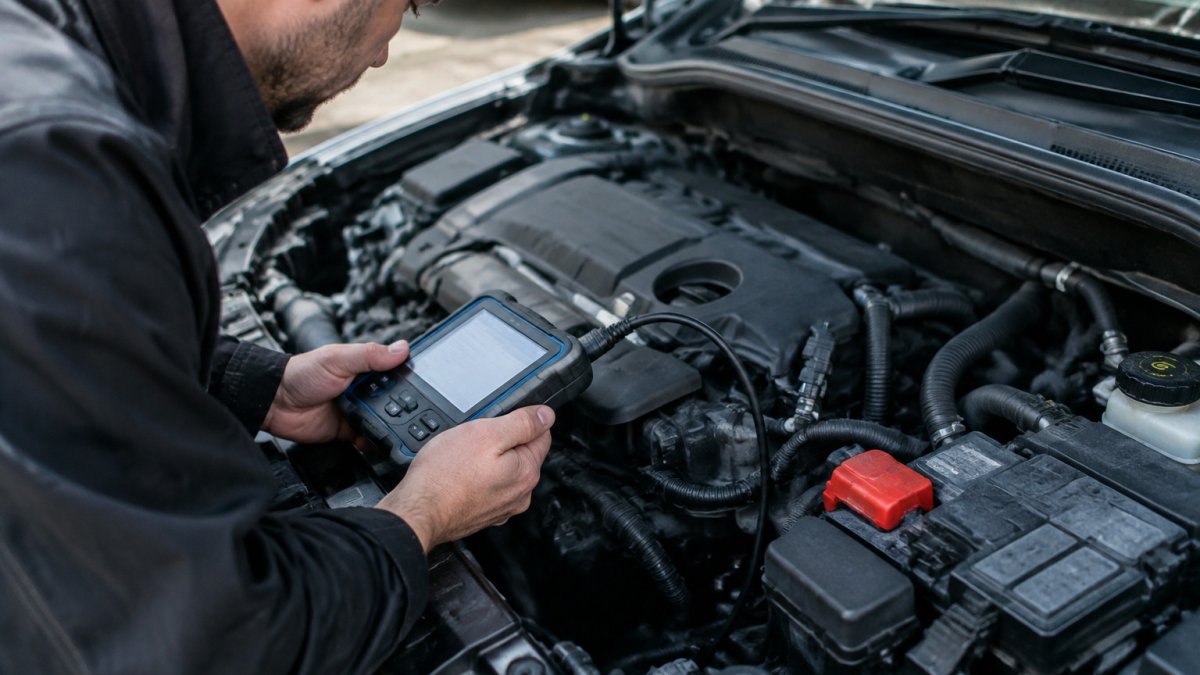
The process starts by plugging a scan tool into your vehicle's OBD port, usually found under the dashboard. On-board diagnostics, or OBD-II on anything built since the early 2000s, is the standardised system that lets a tool talk to the car's computers.
Your vehicle has several control modules, including the engine control unit, gearbox module and ABS module. Each one monitors its sensors continuously and stores a fault code, formally called a diagnostic trouble code or DTC, when readings fall outside expected ranges.
The scan tool reads those stored codes, along with freeze-frame data captured at the moment of the fault. A good technician then switches to live data, watching sensor readings in real time while the engine runs. That last step is where a fault-code scan becomes genuine fault finding.
What Faults Can a Car Diagnostic Test Detect?
A diagnostic test can detect faults across every system that reports to a control module: engine management, transmission, braking, emissions, and the battery and charging circuit. It flags the circuit or component that reported the problem, which is why the same warning light can have several possible causes. The sections below group the common findings by system and note how urgent each one usually is, because a stored code for a faulty airbag is not in the same category as a stored code for a loose fuel cap.
Engine and Engine-Management Faults
Engine management faults are the most common reason people book a diagnostic check. The engine control unit logs codes for misfires, fuel mixture problems, timing issues, and faulty sensors such as the mass airflow or oxygen sensor. A misfire code might point to a worn spark plug, a failing coil pack, or an injector problem. If your engine management light is on, our guide to what that warning means and when a reset is appropriate covers the checks and causes in detail.
Typical engine-related codes include P0300-series misfire codes, P0171 and P0172 for lean or rich fuel mixture, and P0420 for catalytic converter efficiency below threshold. A misfire that flashes the warning light is a stop-driving signal because unburnt fuel can overheat the catalytic converter; a steady light is usually safe to drive to a booked appointment.
Transmission, Braking and Emissions Faults
Gearbox modules log codes for shift problems and sensor failures, while the ABS system reports wheel-speed sensor faults that affect braking performance. On the emissions side, the exhaust system's sensors and the diesel particulate filter both raise codes when efficiency drops. These matter beyond performance: an emissions fault can fail an MOT, so treat these codes as urgent rather than optional.
Brake-system codes deserve particular care. A stored ABS or wheel-speed sensor code can disable anti-lock braking and, on some vehicles, electronic stability control. If the ABS light is on and the pedal feels different, stop and get the vehicle recovered rather than driving it. Transmission codes are usually less immediately dangerous but more expensive to ignore: a solenoid or clutch-pack fault that is caught early may be a repair, while the same fault left to develop can mean a rebuild.
Battery, Charging and Electrical Faults
A weak battery causes a surprising share of warning lights, because low voltage makes sensors report nonsense. Diagnostics check charging-system output and look for electrical faults in components that share a circuit. If you suspect the battery, our article on how to check battery health and spot the warning signs explains what to look for before you replace anything.
Charging-system codes often appear as a cluster of unrelated faults across several modules, which is a useful clue: when the same car reports faults in the gearbox, the ABS and the body module at once, test the battery and alternator before chasing any single code. A charging voltage below roughly 13.5V at idle with electrical loads on is a common sign of a failing alternator.
The AA's guidance on car batteries and warning lights is a useful independent reference for drivers weighing up whether a battery is simply tired or genuinely failing.
Safety and Urgency by Fault Type
Not every code means stop. A red warning light, a flashing engine light, a brake-system fault or an airbag fault should be treated as a prompt-attention or stop-driving issue. An amber engine light with no drivability change, an emissions code or a body-module fault can usually wait for a booked appointment. The report should tell you which category your code falls into, and a good technician will say so plainly rather than leaving you to guess.
Your Car Diagnostic Report Explained
A diagnostic report is a printed record of the codes found, the modules that stored them, and the live data captured during the check. It is written to be shared with a repairer, which is why we print findings rather than recite them. The useful part is knowing what each field actually tells you and what it cannot.

Expect to see four fields. The fault code identifies the system and the fault type. The status tells you whether the code is stored, pending, or historic. Freeze-frame data shows the engine conditions when the fault triggered. Live data shows current sensor readings, which is what confirms or rules out a suspected cause. A code alone is a starting point; the report as a whole is the evidence.
Reading the fields in plain English
A stored code means the fault has been confirmed by the module and the warning light has been requested. A pending code means the module has seen the fault once but not yet confirmed it; it may clear itself or develop into a stored code. A historic code means the fault occurred in the past but is not currently active, which is common after a repair or a battery disconnect.
Freeze-frame data is the snapshot the module saved at the moment the fault triggered. It typically includes engine speed, load, coolant temperature, vehicle speed and fuel trim. If a misfire code is accompanied by freeze-frame data showing the fault occurred at 2,500 rpm under light load, that points the technician towards an ignition or intake issue rather than a fuel-delivery problem that would show up under heavy load.
Live data is the current sensor readings, watched in real time.
An example report
A typical report for a car with a steady engine light might show: code P0171 (system too lean, bank 1), status stored, freeze-frame at 1,800 rpm and 35% load with long-term fuel trim at +18%, and live data showing the same trim at idle with a slight whistle from the intake. Read together, those fields point to an unmetered air leak rather than a failed oxygen sensor. The code named the system; the freeze-frame and live data narrowed the cause. That is the difference between a code read and a diagnosis, and it is the part of the report worth asking about.
The OBD Fault Code Check and Its Limits
An OBD fault code check reads stored codes and tells you where to look. It does not tell you what to replace. This is the single biggest misunderstanding we come across.
A code such as a lean-running fault can mean a split hose, a failing sensor, or a wiring problem. Fitting the sensor without testing the circuit wastes money and leaves the real fault in place. Cheap plug-in readers also miss pending codes, cannot access non-engine modules, and rarely show live data properly.
Watch out: treating a code as a parts list is the most expensive mistake in diagnostics. A confirmed diagnosis comes from testing the circuit and watching live data, not from reading a five-character code.
Basic OBD Checks vs Full-System Diagnostics
| Feature | Basic OBD Check | Full-System Diagnostics |
|---|---|---|
| Modules accessed | Engine only | Engine, gearbox, ABS, airbag, body |
| Fault codes read | Stored codes | Stored, pending and historic codes |
| Live data | Rarely supported | Full sensor and actuator data |
| Freeze-frame data | Often unavailable | Captured and interpreted |
| Printed report | Usually no | Yes, shareable with a repairer |
| Best for | A quick warning-light check | Confirming a fault before repair |
The table makes the trade-off clear. A basic check suits a driver who just wants the light identified. Full-system diagnostics suit anyone about to spend money on a repair, because the extra data is what stops you paying twice for the same fault.
How Long Does a Car Diagnostic Test Take?
A car diagnostic test duration is typically 45 to 90 minutes for a full-system check, including the road test and live-data review that make the results meaningful. A basic code read takes minutes, but it tells you far less.
Intermittent faults take longer, because the fault may not be present when the car is stationary. Booking a mobile check at your home or workplace means the vehicle is available while you get on with your day, which helps when a fault only appears from cold or after a short run.
What to Do Before and After a Diagnostic Scan
Before the scan, note when the warning light appears and what you were doing at the time. Cold starts, motorway speeds and heavy loads all narrow the field. Bring any recent repair history and tell the technician about recent work, since disturbed wiring is a common cause of new codes.
After the scan, read the report before agreeing to any repair. Ask which code was stored, what the live data showed, and which test confirmed the cause. If a garage cannot answer those three questions, get a second opinion. Keep the printed report; it protects you if the fault returns.
The DVSA's MOT inspection manual sets out how warning lights and emissions faults affect test results, which is worth checking if your code relates to either.
Intermittent Faults and Diagnostic Uncertainty
Intermittent faults are the hardest part of this work. A sensor can fail only when hot, or a wiring loom can chafe only on certain road surfaces, so the code may be historic by the time the car arrives. Diagnostic uncertainty is normal, not a sign of a bad technician.
The right approach is to record the conditions when the fault appears, then reproduce them during testing. Where a fault cannot be reproduced, a good report says so plainly and recommends monitoring rather than guessing. We would rather tell you the fault did not show up than sell you a repair that might not fix it.
Book a Mobile Diagnostic Check at Your Home or Workplace
Warning lights rarely appear at a convenient moment. That is exactly why we built Licence to Chill around mobile visits: our IMI-qualified father-and-son team brings the diagnostic equipment to your driveway or workplace car park, so a fault-code scan fits around your schedule rather than replacing it.
Our Chill & Check package includes a diagnostic scan with printed findings, a cooling performance check and a 12V battery health assessment. You get clear advice on what the report shows, and a document you can hand to any repairer. Before booking, you can check whether your postcode falls within our mobile service area, and when you are ready, book a mobile diagnostic check at a time that suits you.
If a warning light has been on for weeks, the uncertainty usually costs more than the check itself. Get started with Licence to Chill and get a clear, printed picture of your vehicle's health without losing a day to a garage visit.
Frequently Asked Questions
What does a car diagnostic test show?
A car diagnostic test shows stored and pending fault codes, live sensor readings, freeze-frame data captured when a fault occurred, and the status of control modules across the vehicle. It tells you which system has logged a problem and what the sensors reported at the time. It does not confirm the exact failed component on its own, which is why a diagnostic report is a starting point for fault finding rather than a final answer.
Can a car diagnostic test identify the exact problem?
Not always. A fault code points to a circuit or system, not a specific part. For example, a code for a lean fuel mixture could mean a split hose, a failing sensor or a blocked injector. A competent mechanic uses the report alongside live data, visual inspection and test procedures to confirm the cause. Treat any provider who promises a guaranteed part from a code alone with caution.
Does a car diagnostic test check the battery and charging system?
A full-system diagnostic can read battery voltage and charging-system data through the control modules, but a dedicated battery test gives a clearer picture of battery health, cranking performance and alternator output. If your warning light or starting issue points to the battery, ask for a proper 12V battery test as well as the scan. Mobile providers can carry out both at your home or workplace.
Can a diagnostic test clear a warning light?
A scan tool can clear a warning light, but clearing a code without fixing the cause usually means it returns, sometimes within a few drive cycles. Clearing codes also wipes useful freeze-frame data that helps with fault finding. Have the fault investigated first, then clear the code once the repair is confirmed. A diagnostic check should explain what triggered the light, not just switch it off.
How long does a car diagnostic test take?
A basic OBD fault code check takes around 15 to 20 minutes. A full-system diagnostic with live data review and a printed report typically takes 45 to 60 minutes, depending on the vehicle and how many modules need scanning. Intermittent faults that require a road test can take longer. Ask the provider for an expected time before booking so you can plan around work or calls.
What should I do after receiving a car diagnostic report?
Read the report's summary first, then note which systems logged faults and whether they are stored, pending or intermittent. Ask the provider to explain anything unclear and to rank the faults by safety urgency. Share the printed report with whoever carries out the repair, as it saves repeat diagnostic time. Fix safety-critical faults such as braking or steering issues promptly, and monitor lower-priority items at your next service.
